I received a copy of this book from the publisher to facilitate my review. As always, all opinions expressed here are entirely my own.
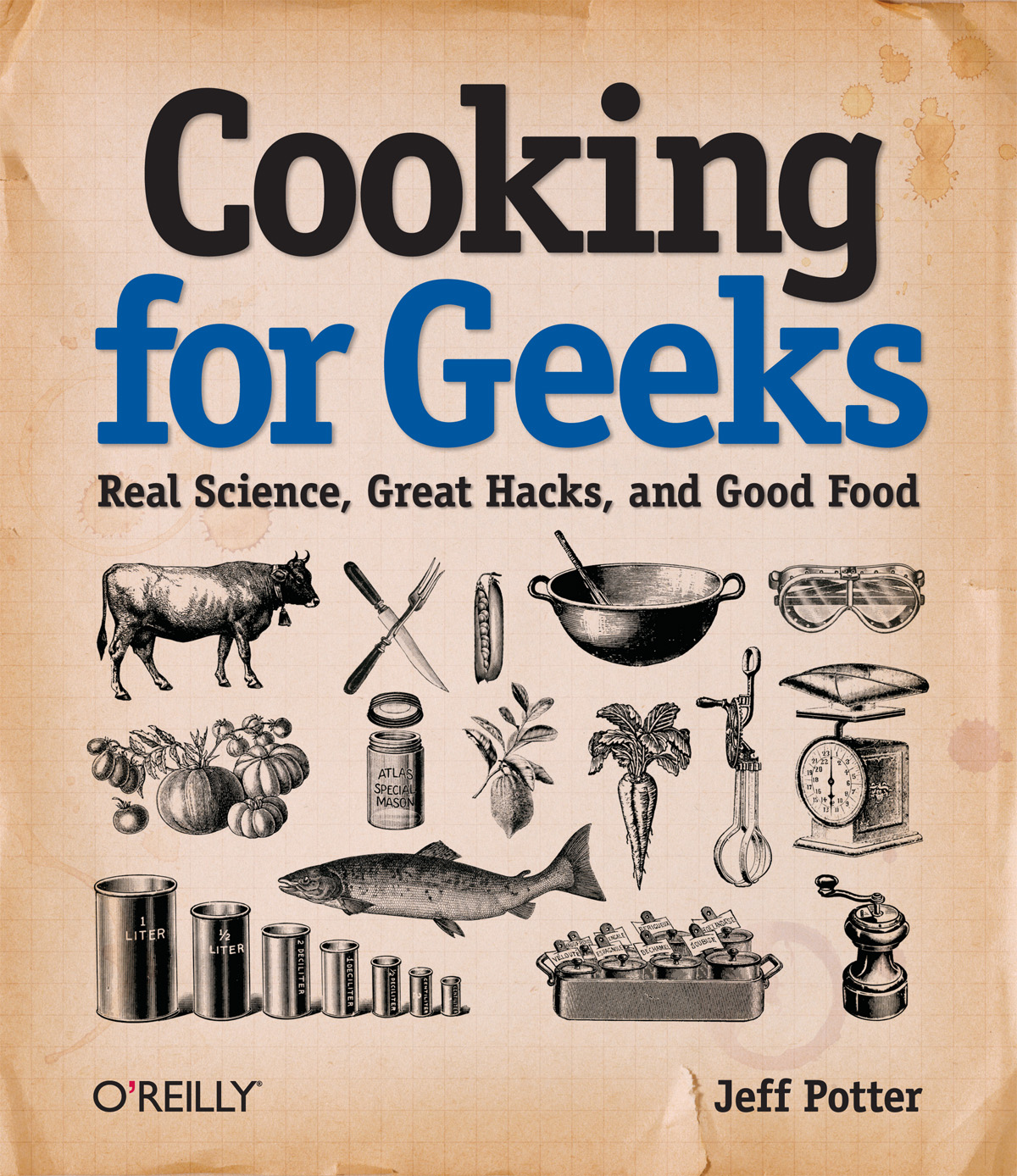
Okay, this is a super-cool book, which I’ll get to in a minute, but first can we talk about this cover? The background of this cover is so realistic I keep thinking I’ve smashed my book. I can’t decide if that’s brilliant or obnoxiously annoying. We don’t want to judge the book by its cover, though, so let’s move on to the insides.
Cooking for Geeks
In case you’re wondering, Cooking for Geeks would make a great last-minute Christmas gift for the right recipient. It’s practical, but it’s also a lot of fun. (Side note: My fingers want to keep typing Cooking for Greeks. Which would be a totally different book. Hopefully I’ll catch all the goofs and fix them, but if I miss one, just enjoy the laugh and overlook my overzealous typing fingers, okay?)
It’s about an inch thick, but it’s on sort of a magazine-type paper (glossy) that enables it to be really dense and heavy, so this hefty book contains a whopping 450 pages, not including the index. It’s broken down into six major sections:
- Hello, Kitchen!
- Taste, Smell, and Flavor
- Time and Temperature
- Air and Water
- Fun with Hardware
- Playing with Chemicals
There are also handy indices to the recipes, labs, and interviews found throughout the book in case you want to jump straight to one of those. Following the major sections, there are a couple appendix-type sections. “How to Be a Smarter Geek” suggests a handful of additional resources to check out. “Cooking Around Allergies” provides some tips about ingredients to avoid, as well as handy substitutions, for a few common allergens.
What it Isn’t. What it Is.
Cooking for Geeks is not, primarily, a recipe book. In fact, in the whole 450 pages, there are only 100 recipes (assuming I counted right). What it is, is a book about cooking. It isn’t a book about cooking in a vague sense, but in a “how things work” sense, making it really fascinating for those interested in science and related subjects. The recipes span a broad spectrum — gourmet (duck confit) and basic (mac & cheese), all courses (soups, salads, breakfast, mains, dessert, etc.), and so on. They cover a broad skill set. You will, for instance, learn how to bake bread and how to make a sauce.
But where the book really shines is its overall tone, which sets it apart from any other “how to cook” book. The book is clearly written to “geeks.” It shows in the examples offered. It shows in the explanations given. It shows in how the reader is instructed regarding when it’s important to play by the rules and when it isn’t. And “expert testimony” is brought into the picture in the form of a variety of interviews (about cooking) with famous people scattered throughout the book.
Hello, Kitchen!
Hello, Kitchen lays the foundation. You’ll quickly discover that this is a book intended to be accessible even to someone with virtually no comfort level in the kitchen. We’re told how to determine what our cooking style is, how to read a recipe, how to not always follow the recipe, best practices for cooking, and some fundamentals of kitchen equipment. Everything is addressed as though you don’t have any idea what you’re doing (in case you don’t), but there’s never a hint of condescension, because the author also assumes you’re smart. The focus is on how to develop the right kinds of thought processes rather than on being a “have” or “have not” in terms of knowledge. Recipes and labs provide opportunities to practice. (This is true throughout the book.)
Taste, Smell, and Flavor
This chapter begins by getting into the science of taste. It then discusses the various flavor elements to provide the knowledge essential to combining flavors for yourself. (This is one of my weaknesses in the kitchen. I can play with a baking recipe and still have it work, but I can’t create flavor combinations on my own with any consistent success.) It includes a chart showing some of the frequently-used flavors from various cultures. There are even a few chemical diagrams in this chapter, for the science-savvy! (If that’s not you, you can skip over them. They aren’t essential to the flow of the content.) The variety of methods discussed here for finding flavor inspiration, together with the multiple (mostly-basic) sauce recipes provided in this chapter, make for a pretty strong beginning to flexibility in the kitchen.
Time and Temperature
Time and Temperature is an especially science-y chapter. This is where we talk about types of heat transference, denaturing of proteins, melting points of fats, etc. Along the way you’ll also learn why you can’t just crank up the oven and reduce the cook time, how (and why) to keep foods within a safe temperature range, how to temper chocolate and what makes it seize up sometimes, differences between various cooking fats, browning and caramelizing, etc.
Air and Water
In this chapter, air and water are discusses as variables that impact cooking. We read about high-altitude baking adjustments. We learn about steam. We read about different types of wheat. (This is information I’ve always found really cool. There’s a reason certain baked goods are traditional to certain regions!) This chapter talks about types of flours, variables in baking, and gets into the baking of bread and what is involved in that process.
Fun with Hardware
This final section is basically a mish-mash that introduces a variety of “gadgets” and the foods made with them. Pressure cookers are discussed here. Molded foods are found here. (The gelatin mold/cookie cutter type of mold. Not the penicillin-and-cheddar sort of mold.) There are some experiments and discussions of separating foods by filtration, centrifuging, and drying. We also read about making ice cream, and about high-heat-baked pizzas. (How can you go wrong with a chapter that has ice cream and pizza?)
A Few Final Notes
Because this is about the science of cooking, not the nutrition of food, not every recipe in here is one I’d consider “real food”-friendly. However, the lessons learned are probably well worth the preparation of most of these items at least once, just for the “science experiment” of it. Also, there was a coarse word or two in a quote. I haven’t read every word of the book, so I can’t swear there aren’t one or two other similar instances, so just be aware that it’s a book written for adults and there is the occasional evidence of that. I don’t personally feel it’s significant enough to negatively affect the book; I’ll just skip over the line or two. At worst, you could take a permanent marker to those sentences.
This could be an excellent graduation gift or gift for a college-age young adult out on his (or her) own and not too sure how to feed himself. (It also does a good job spinning the idea of cooking toward something we all do, and away from the notion of cooking as exclusively “women’s work.”)
Another perfect use for this is as material for homeschool lessons. Either you can go through the whole book as a cooking/science course, or you can pull out particular sections for lessons on particular cooking skills or scientific concepts.
Definitely going to be a new favorite!

Leave a Reply