I was provided by the author with a copy of this book to facilitate my review. As always, all opinions expressed here are entirely my own.
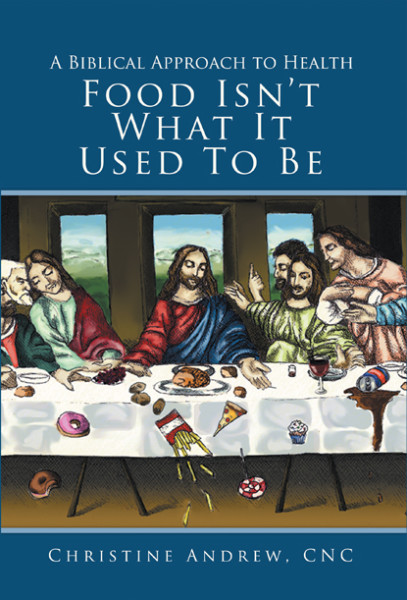
Unfortunately, in this day and age, it’s hard to find nutritional information that takes a biblical tack. Given that God’s Word is the only unchanging standard we have, that’s a real shame! So coming across Christine Andrews’s Food Isn’t What it Used to Be: A Biblical Approach to Health was rather refreshing.
Overall “Feel”
My reaction to the book is mixed. It probably could have used an editor, because I felt it could have been better organized. And it reads a bit like a thesis or term paper. (Possibly it was the author’s thesis.) However, if you don’t mind a little “heavy reading,” there’s some good information here.
Structure & Content
The book starts with the foundation that we are created in God’s image. It builds on that with a solid chapter about all of the major factors that contribute to imbalance. This chapter is well-rounded. Inherited toxins, spiritual toxins, mental/emotional toxins, physical toxins, and external energy field disturbances are all addressed. I really appreciated that the author confronted the fact that all of these can contribute to ill health. (And when you put them all together…)
It then moves on to describe the standard American diet (often referred to as SAD). This diet is, of course, full of foods that fail to contribute to health, and often even undermine it. The next chapter breaks this down, explaining some of the reasons our modern food supply is not doing us any favors. Nutritional deficiencies. Chemicals in our foods. Genetically-modified plants. And more.
Finally, it gets into ways we can improve our health. This is the most useful portion of the book, for obvious reasons. It’s also the area of the book where I found the most disagreement, personally.
Improving Our Health
First, the author talks about detoxification. It’s a fairly brief, but pretty thorough overview, suggesting a number of different methods. Fasting is given a somewhat longer portion, as is “drainage” (the process of keeping the normal elimination systems working efficiently).
Then we get into the diet and God’s design for food, and here I have to disagree with some of the conclusions.
The general dietary suggestions have the potential to be rather confusing, because they aren’t consistent. Page 81 suggests a paleolithic diet, while page 82 recommends a plant-based diet. These two diets are inherently at odds. Generally speaking, though, there are some good recommendations here.
I don’t believe it’s necessary for 51% or more of our foods to be raw. I’m not sure that a study of Scripture would show this to be normative for the diet in that time/place. I’m also not too sure about the idea of our diet needing to be sufficiently “alkaline.” Most of the foods villainized for being too “acidic” were pretty common and significant portions of the biblical diet.
I disagree with the statement that “the best sources of calcium are from greens, spinach, kale, broccoli, seeds, and nuts.” Seeds and nuts may be adequate sources of calcium, but greens are generally not going to be the most efficient calcium sources. Calcium requires fat for its assimilation — something which green vegetables inherently lack. This is one of the reasons full-fat dairy has been so highly recommended as a calcium source for so long: the fat in the dairy enables the calcium to be well-utilized by the body.
A few of the specifics contain questionable “facts,” inspiring me to question the dependability of some of the text. For instance, the section about the paleolithic diet describes it as being a throwback to the “prebiblical” era. The problem is, from a biblical standpoint, there is no pre-biblical era. “In the beginning, God…” What comes before that? (I realize that not everyone will take issue with this as “fact,” but we’re operating on the assumption that Scripture is the standard in this text, given its title.)
Grain preparation in ancient times did not generally involve the removal of the bran/germ. That’s what turns whole-grain flour into white flour — something that didn’t happen among the masses until around 1900. Most of the nutrients are concentrated in the germ (and the fiber in the bran); the very fact that this was left intact is the biggest reason (or at least one of the biggest reasons) grain-based foods were so much healthier in ages past.
However, please don’t take this as indication that the book is of little value. There is a good deal more in here that’s useful than that which is questionable.
What artificial sweeteners are in regular use, and what alternatives are available? (I don’t personally like to rely on sugar alcohols, which are included among the potential alternatives, but at least they’re clearly described for what they are.) Why is salt good — and why is modern table salt not good?
What are truly healthful/not-healthful fats? (It correctly avoids demonizing naturally saturated fats, which are perfectly healthy.) Why do we need protein? How are fermented foods beneficial? What is wrong with pork and seafood? What makes for healthy water? (This includes a discussion of fluoridation & chlorination.) What about milk? Fresh air? Managing stress?
More
After all of this, there’s a 6-page summary of principles to keep in mind, foods to look for, and ingredients to avoid. It’s the “nutshell version” of how to live a healthy lifestyle, and it’s pretty helpful. There’s a suggested list of foods to stock a biblically-inspired whole-foods pantry. There’s a sample ancient meal plan, followed by a handful of recipes.
And a few more handy pages: descriptions of what certain food label terms mean, and summaries of essential oils & herbs mentioned in the Bible, along with how certain biblical ailments might have been treated.
My Take
As noted, I have some concerns about a few of the specific details. But overall I find this to be a helpful resource. It does a great job of packing a lot of information into a fairly small space. I especially appreciate the holistic nature of the book. What we eat, what we drink, the air we breathe, the toxins we surround ourselves with (or don’t), the stress we sustain, and our mindset all contribute to our health, but rarely are they all addressed in tandem like this in a text. When you’re done with Food Isn’t What it Used to Be, you might find yourself wanting to read more on any one of these subjects, but you’ll have a good “big picture” idea of how your lifestyle contributes to your health, for better or for worse.

Leave a Reply