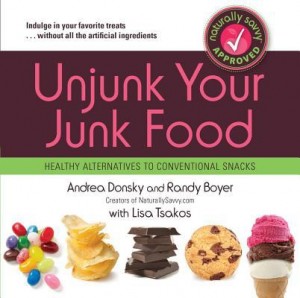
 Unjunk Your Junk Food is the first publication from Naturally Savvy. (Some of you are probably familiar with Naturally Savvy, because their blog has been around for a while. Only the book is new.)
This unique book suggests specific alternatives to conventional snacks. It can be either very helpful or not-very-helpful, depending on your needs and your circumstances.
Learning What to Look For
The most helpful part of the book, in my opinion, is the opening section. This talks about what to look for on food labels. Among other things, it tells you what ingredients are really awful and should be avoided (red flags) and what ingredients are “iffy” (yellow flags). If you’ve been eating whole foods for a while already, it is unlikely that any of these will be news to you. (I was impressed that they didn’t paint saturated fats as villains.) If you’re new to eating healthily, this could be very helpful information. I learned a little bit about why a few of the ingredients aren’t good for us, that I didn’t know before.
The Comparisons
The bulk of the book is comprised of two-page spreads. On the left is a conventional snack food – the food is pictured, and the ingredient list is provided, with “red flag” and “yellow flag” ingredients printed in red and yellow, respectively. On the right is another commercially-available snack, roughly equivalent, with its ingredient list. Surrounding these two foods are additional explanations, tips, and information.
Although it’s helpful to see what the authors were looking for, I didn’t find this portion of the book to be especially useful, overall, as a tool. Most of the “Naturally Savvy-approved” options are brands that aren’t available in my local stores – even the health food stores or health food aisles – so it doesn’t help me to know they’re better – I can’t get them! I would have found it more helpful to have a list of options (‘though some entries do have “honorable mentions”), and/or recipes for making my own similar snacks.
Some of the “better choices” are just simply not equivalent in the mind of anyone who isn’t a “health food nut,” so they don’t make good substitutes. (Sometimes things can even taste good, but they aren’t good substitutes for something else. Mashed cauliflower is tasty, but don’t try to tell me it’s “like mashed potatoes”!) For instance, in place of Reese’s Cups (which contain preservatives), the authors recommend Sun Cups. Sun Cups are made with sunbutter (sunflower seed butter), which tastes absolutely nothing like peanut butter. Sun Cups may be good (I don’t know; I’ve never seen them in real life, much less tasted them), but I am 100% certain they are not a fair replacement for Reese’s Cups!
And on occasion, there is just incorrect information. Barbara’s Fig Bars are suggested as a replacement for Fig Newtons. So far, so good. But according to the text, “the fact that they’re wheat and gluten free means that even more people are able to enjoy them.” In huge letters, the package says, “Whole Wheat.” Oops.
Overall Impressions
I do understand why the book was compiled the way it was. Sometimes we don’t have time to make our own, or just don’t want to, or need to grab something on the run. It’s good to know what the reasonably healthy options are. (“Healthy” being a somewhat loose term in this context, as we are talking about junk food, so there’s plenty of sugar here, any way around it!) But I would have found it more useful if there had been more to it. Give me other options, in case this one brand isn’t in my store. Tell me how to make my own, for when my time isn’t at quite such a premium.
Checking My Pantry
So what’s in my pantry? Well, most of the book’s “red flag” ingredients are ingredients we already try to avoid. So, for instance, we eat the recommended Turkey Hill and Breyers natural ice creams because they aren’t full of weird stuff. (And there are some things – like Pringles – I know have junk in them that are in my cupboard because other family members insist. 😉 ) But are there any surprises? Let’s take a look…
I couldn’t find any surprises in our junk food. We currently have Pringles, Chips Ahoy, Coke, and hot cocoa mix in the pantry, each of which contains red flag ingredients – but I already knew that. The snacks I thought were free of ickies really are. (Well, I’m sure most of them have genetically-modified ingredients in them, but there’s nothing we can do about that as long as the government insists on protecting Monsanto against having to label those for us.)
What’s in Your Pantry?
How ’bout your pantry? Do any of your snacks contain:
- high-fructose corn syrup
- hydrogenated or partially hydrogenated oils
- MSG/monosodium glutamate
- artificial flavors
- artificial colors
- artificial sweeteners (aspartame/Nutra-Sweet, sucralose/Splenda, acesulfame potassium, saccharine…)
- preservatives (polysorbate 60, 65, or 80; TBHQ; sodium benzoate; BHA; BHT, sulfur dioxide)
Is there something you could swap out? Even little changes add up!
Disclosure: I was provided with a copy of the book to facilitate this review/post. As always, all opinions expressed here are entirely my own.

As I am chemically sensitive I bought this book at Barnes & Noble & have found it to be incredibly useful when I shop, as I can apply the advise given to any products I buy. BTW having tried he Sun Cups I have found the taste to be just like peanut butter..
That’s good to know! I haven’t tried the Sun Cups – just sunbutter, in general.
Sunbutter is not the same company as Sun Cups – have tried both & they’re both taste great!
]
Sounds like a book i could use!
I ordered this book from Amazon a couple months ago. It really opened my eyes to how widespread these bad ingredients are in packaged foods and what exactly they do to our bodies. It’s scary to think about. It’s made me much more diligent about checking the ingredient list before buying anything. Especially with preservatives and artificial colors/flavors… since reading it I’m much more aware of the many varieties there are. It’s one of those books moms, in particular, should have handy.