As part of the Z Blog Squad, I was provided by Zondervan with a copies of each of these books to facilitate my review. As always, all opinions expressed here are entirely my own.
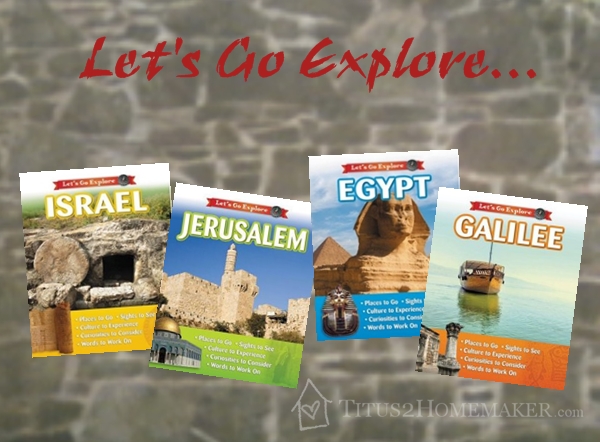
Let’s Go Explore…
I knew as soon as I saw these that they would be great for our ancient history studies. I was not disappointed. Each book is full-color and divided into five sections titled “places to go,” “sights to see,” “culture to experience,” “curiosities to consider,” and “words to work on.”
The Let’s Go Explore series is designed for fairly young students, so the books don’t go into great depth. They do, however, hit on a broad variety of topics and present them in a way that young readers can grasp. For instance, we read that it would be possible to cross Israel from east to west “in about the same time it takes to watch a movie.”
If you’ve ever seen one of those “magazines” designed for toddlers – like the little National Geographic magazines – these look a little like that, in terms of their color, layout, etc. (They’re longer, though, I think. Each of these is 48 pages.) They’re bright and colorful, with lots of variety in the design to keep children’s interest. At the same time, though, they’re linear enough that they’re easy to follows. (Sometimes, with books like the ones from Usborne or DK, there is so much “scattered” around a page it’s hard to know what to read when. These don’t have that issue.)
I was really impressed with how well the books integrated ancient and modern information. You’re largely reading about these places now – but with lots of references to how that relates to then: what places used to be called, what biblical events occurred there, etc. There are also some interesting tidbits about how modern technology is enabling us to find, preserve, and learn from artifacts of the past.
And I learned a lot even from just the first book I read! (I’m not sure if that reflects well on the book or poorly on me! 😉 ) Did you know that the Arabah gets less rainfall each year than Death Valley – and yet farmers grow dates, figs, melons, and other produce there?! That is some serious agricultural skill! And over 90% of Israeli homes use solar power for heating their water! (Maybe we should study Israel when we study agriculture & stewardship, too.)
Nations & Regions
Of course Israel and Egypt are nations, but Galilee and Jerusalem are regions within Israel. This enables the latter two books to go into greater detail. (As a result, I think they have a little more biblical history in them than the others. That’s not a statistical fact, just my gut observation.)
Any “issues” I might have with these books are pretty minor. I thought the selection of holidays highlighted in the Israel book was a little odd. It’s only a partial list, and there wasn’t an obvious rationale for why certain ones were chosen or omitted. And some of the birds and other wildlife pictured in the books aren’t captioned by name. A child is not likely to even notice these things, though, and there’s so much that is in the books, I’m not especially concerned about what isn’t. (It’s not as if these are our total curriculum or something.)

Leave a Reply