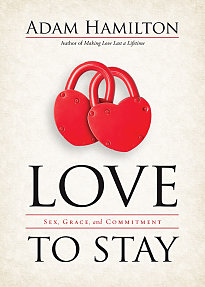
When I was approached to review Love to Stay: Sex, Grace, and Commitment, I wasn’t entirely sure what to expect. Adam Hamilton is a pastor, but I’d never heard of him before, so I didn’t know anything about him. Would the book be biblical? Or liberal?
Well, my review copy arrived and, while I have some mixed opinions on various parts of it (which I’ll get into in just a moment), overall I have a very positive impression of it. It is certainly thought-provoking, and it takes a new approach the questions involved in keeping marriages strong.
The Basis
The basis of Love to Stay is a survey the author did. Over 5,000 respondents were involved, including married, single, divorced, and widowed individuals. The majority of the respondents are connected with the author’s church in one way or another, so the results should be expected to be skewed toward the faith-based and not necessarily a representation of the American culture at large. Still, they’re close – and should give us some general ideas of trends.
Concerns and Questions
I had a couple of questions/concerns – or puzzling observations.
The two biggest concerns are that:
- The author seems to miss the idea of simply not allowing for divorce at all. Whether a couple goes into a marriage believing divorce is an option can make a huge difference in how likely the marriage is to last. Unfortunately, this is just not brought up at all within the book.
- The section about “big issues” that can “shipwreck a relationship” made too much allowance for divorce, too, in my opinion.
Let’s talk a little bit more about that. It may be that these “big issues” would be more precisely dealt with in a context that allots them more space. I felt that this section was perhaps overly simplistic and, therefore, just kind of concluded that “it’s okay to get a divorce if you’re dealing with big issues.” There are a couple of concerns with this. First, there is a difference between separation and divorce. Biblically, this can be an important distinction. Second, “addiction” is treated as one of these “big issues,” even though addiction and, say, abuse arising from addiction, are separate issues in the survey.
And, finally, these issues are misrepresented as being more significant (as far as statistical numbers, I mean, not severity) than they actually are. The chapter calls these the “top three issues…cited” in the survey as causes for divorce. While this is technically true – these are the top three individual reasons offered – it’s a bit misleading. The reader is left with the impression that most divorces are due to these “big” causes. They’re not.
Even when taken all together, infidelity, alcohol or substance abuse, physical/emotional abuse, and mental illness (which is not addressed in that chapter, but I would consider a “serious” issue) only account for 35% of divorces, according to the survey. That means that roughly 2/3 of divorces are for far less significant reasons. This fact is glossed over.
However, apart from the fact that the author allows for divorce where I believe the Bible does not, the advice given seems, overall, to be sound.
More Minor Puzzles
A couple more minor puzzles I found are not related to the author but, rather, to survey results I found baffling. Married men 19-29 ranked sexual intimacy third in response to a question about “what…your spouse does that make you feel closest to her.” For married men 50-69, it dropped to fifth, and for men 70+, it dropped off the chart altogether. (It was #1 for married men 30-49.) For single men, attractiveness was ranked third on a list of desirable traits in a mate. Yet “I wish she were more interested in sexual intimacy” ranked first among the things married men most wished they could change about their wives.
This seems like a bit of a discrepancy to me, like the men are telling us that sex is less important to them than it is in actuality. That seems rather unfair. Women’s lists had a similar discrepancy, although it isn’t quite as clear-cut because their top values (like honesty) tie in with their top requested change (better communication).

It is also worth noting that one of the things the author points out can contribute strongly to a better marriage is regular “performance reviews,” where you assess the state of things together and determine any course corrections that need to be made. This is exactly what the women are asking for – better communication! (Hear that, guys? Communication really is important!)
The last bit of statistical information I found baffling was the length of time couples had been married when they got divorced. The survey showed that more divorces occurred between 11 and 20 years. This doesn’t mesh with my observations of the people around me, most of whom (if they are divorced) have been divorced within the first five years of marriage. I would be interested to see this same question studied by age or generation, because I wonder whether those who have been married in recent years are more likely to divorce quickly than those who were married in the past.
Good Stuff
Despite these minor “glitches” in the survey results, the bulk of the information provides some very helpful insights. (It can also provide some opportunities for discussion, as you read the results and determine where they do – or do not – match up with your own preferences. Would your top 5 be the same as the overall top 5? Or not?)
The author makes some observations and assumptions, as well, that can be helpful. For instance, we may not know for certain why certain things happen during certain stages of life – but when we see trends we can make educated guesses as to what might be causing them, and this type of information can be valuable, as well.
One thing I really liked about the book is that there are opportunities to “reflect and engage” at the end of each chapter. These are exercises to help you apply the information to your own life. And even better, there are activities for singles provided here, not just for those who are already married. I appreciate that the singles were not overlooked.
An overview of all of the survey results is included in an appendix, if you want to take a closer look.

(I love this quote. This is so true! Respect and honor the marriage bed – but don’t take it too seriously, either.)
The final thing I want to mention is the tone of the book. It’s real. There is no question that the author is a real man with a real marriage. He doesn’t try to gloss over the fact that he and his wife have had their own struggles, or that a good relationship is hard work. He demonstrates a sense of humor. In short, it’s relatable.
With the one caveat about divorce still being more of an option than I’d like to see, I would definitely recommend this book.

Leave a Reply