Note: Many of my recent health-related posts are adapted from school papers. The following is reproduced with little change from an assignment turned in for my herbalism class.
Mullein (pronounced MULlen) is, according to the Natural Medicines Database, “among the oldest known medicinal plants,” having been used for centuries (Mullein, 2015). The name may refer to any of several closely-related plants, all with essentially the same therapeutic properties, but the most commonly used is Great Mullein (Verbascum thapsus).
Identification of Mullein
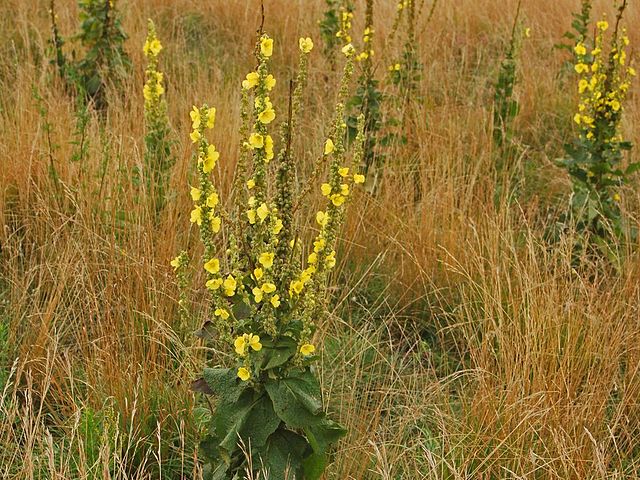
While in flower, mullein is easy to identify, although prior to flowering one must be careful not to confuse it with comfrey (Symphytum officinale) or foxglove (Digitalis purpurea or D. lanata; Petersen, 2015). The biennial plant produces only a rosette of leaves in its first year. These leaves may be anywhere from 6 to 15 inches long and the overall plant vaguely resembles a fuzzy cabbage.
In its second year, the plant puts up a flower stalk. The same greyish-green leaves alternately climb the stem, and are very large – approximately the size of an average woman’s foot – near the bottom and gradually become smaller nearer the top. The leaves near the top hug the stem more closely, too. Sometime in May to early September, the top of the stalk is covered with golden yellow flowers each approximately an inch in diameter. These cup-shaped flowers are comprised of five rounded petals each, and sit directly against the stem.
The plant may grow very tall. At its shortest it may be only a foot tall, but can be as much as 6- 8 feet in height. When in flower, the plant bears a rudimentary resemblance to stalks of corn! The stem itself is very thick and woody, with a texture somewhat like celery when cut or torn. If wildcrafting, be sure to bring cutters.

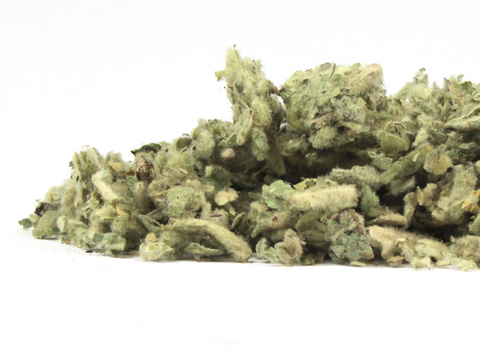
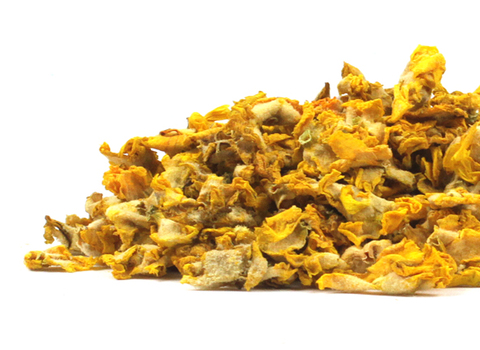
The overall plant is very sturdy; however, the individual flowers and leaves are somewhat delicate. The flowers must be handled gently to prevent bruising, and dried well, or they will turn black (Petersen, 2015). The leaves, which should ideally be gathered prior to the plant’s flowering, also should be handled gently to prevent crushing. They have a “fuzzy” appearance due to the profusion of branched hairs that cover both sides. These hairs may cause irritation. Leaves, flowers, and occasionally the roots are all used medicinally.
Mullein’s Traits
Constituents in mullein include flavonoids, mucilage, glycosides (particularly aucubin), saponins, tannins, and a small amount of volatile oil (although not enough that the plant is used for essential oil production). A wide variety of therapeutic actions are attributed to mullein; each source provides a slightly different list. Most, if not all, indicate the plant is expectorant, demulcent, anti- inflammatory, antispasmodic, astringent, and vulnerary. It has also been described as antitussive, anodyne (Tierra, 1992), mildly antiviral – especially the leaves and particularly against Herpes simplex and influenza (Foster & Duke, 2014), alterative (Tilgner, 2009), anticatarrhal (Mills & Bone, 2005), hemostatic, analgesic, sedative, nervine (Frawley & Lad, 2001), anthelmintic, antibiotic, antioxidant, antiseptic, diuretic, emollient, nutritive, and renoprotective (Petersen, 2015). Tilgner says the flowers are more demulcent, while the leaves are more astringent. Notably, mullein is also mildly narcotic, but not poisonous or addictive, which is a rarity (Petersen, 2015).
Virtually all sources agree that mullein has a particular affinity for the respiratory system.
Some also indicate it is beneficial for the nervous, urinary, digestive, and/or lymphatic systems, each of which is borne out by the indications offered by several other sources.
Mullein Leaves Mullein-infused OilMullein Flowers
Use
The herb’s actions and affinities provide key clues to its most common uses. In general terms, mullein is beneficial in nearly all respiratory illnesses, including whooping cough and influenza; it is useful for glandular swellings, including mumps; it soothes inflammation, particularly of the mucous membranes; and it is helpful for reducing excessive fluid production of varying types. It may be taken as a tea or infusion, which should be well-strained to remove the tiny leaf hairs which may otherwise cause irritation in the mouth and throat (Grieve, 1971). An infused oil made from the flowers is well- known as a treatment for ear infections (a few drops of the oil are placed directly in the ear), and may also be used to soothe hemorrhoids or other mucous membrane inflammation. In years past, it was smoked, either in a pipe or rolled into cigarettes, as a means of relieving spasmodic coughs and asthma (Grieve, 1971). The leaves are sometimes used as poultices.
In energetic medicine, such as Ayurveda, mullein is considered a cooling herb. Of the six Ayurvedic flavors, it is said to provide bitter, astringent, and sweet. It reduces pitta and kapha, and may aggravate vata, due to its drying nature (Frawley & Lad, 2001).
Safety
Mullein is safe for use during pregnancy or lactation (Mills & Bone, 2005). According to Mills and Bone, there are no known contraindications, warnings, adverse reactions, or drug interactions. However, Mosby’s suggests the possibility that, due to the high mucilage content, mullein may reduce the absorption of some oral drugs. This risk can be alleviated by taking mullein at least 2 hours before or after a dose of medication (Harkness & Bratman, 2003). Also keep in mind the previously- mentioned potential for irritation from the leaf hairs when creating preparations.
References:
Bruton-Seal, J. & Seal, M. (2009). Backyard medicine (pp. 36, 110-13). New York: Skyhorse Publishing.
Foster, S. & Duke, J. (2014). A field guide to medicinal plants and herbs of eastern and central North America (3rd ed., pp. 158-59). Boston: Houghton Mifflin Harcourt.
Frawley, D. & Lad, V. (2001). The yoga of herbs. Twin Lakes, WI: Lotus Press.
Grieve, M. (1971). A modern herbal (vol. II, I-Z, pp. 562-566). New York: Dover Publications.
Harkness, R., & Bratman, S. (2003). Mosby’s handbook of drug-herb and drug-supplement interactions. St. Louis: Mosby.
Hoffmann, D. (2003). Medical herbalism: The science and practice of herbal medicine (p. 592). Rochester, VT: Healing Arts Press.
Mills, S. & Bone, K. (2005). The essential guide to herbal safety (pp. 512-13). St. Louis: Elsevier
Mullein. (2015). Natural Medicines Database. Retrieved October 15, 2015.
Petersen, D. (2015). HERB 201: Herbal studies (pp. 325-331). Portland, OR: American College of Healthcare Sciences.
Peterson, L. (1977). A field guide to edible wild plants of eastern and central North America (p. 72). Boston: Houghton Mifflin Company
Tierra, M. (1992). Planetary herbology (p. 389). Twin Lakes, WI: Lotus Press.
Tilgner, S. (2009). Herbal medicine from the heart of the earth (p. 125). Pleasant Hill, OR: Wise Acres
Photo of mullein in the field is by Ettore Balocchi [CC BY 2.0], via Wikimedia Commons
Disclaimer: All information in this post is provided for educational purposes only. Some of the listed uses of mullein have been arrived at by scientific study; others are traditional uses.

Leave a Reply