
Some Not-So-Good Stuff
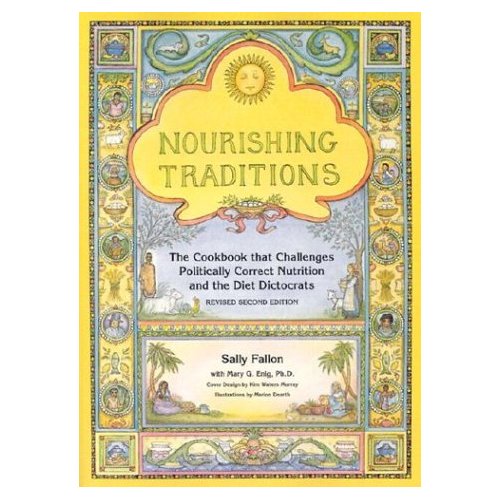
Nourishing Traditions has definite strengths and weaknesses. On the negative side, it is first of all not very practical for those completely new to whole foods cooking. Nearly all of the recipes are “weird”: not the kinds of things that normal people will be willing to eat (especially hard-to-convince hubbies!). Very little basic “how-to” information is given. For example, there is a list of alternative sweeteners, telling the reader what each one is, but it does not explain how to use them.
There is an extremely strong emphasis on the “need” to soak and/or ferment all grains and flours before use, all the time, under all circumstances. This “need” is not well-supported, and process can be quite burdensome for some families. Some of the recommendations (as the need to soak grains, above) are not well-documented. Others are anti-biblical or in opposition to common sense. For example, the author recommends eating raw meat along with its accompanying fat. (“You shall not eat fat or blood.”) She also recommends soaking all fruits and vegetables in bleach water prior to use. This despite the fact that chlorine is a known carcinogen, and we should be filtering it OUT of our water.
But Lots of Good Stuff
On the other hand, some aspects of the book are extremely well-documented, and fascinating! Did you know that blood cholesterol levels have never been proven to be related to heart disease? Did you know that saturated fats have not been proven to contribute to heart disease, or to raise cholesterol? Rather, polyunsaturated vegetable oils have been linked to heart disease and our bodies need saturated fats. Fats help our bodies to assimilate sugars gradually, nourish our glands, maintain normal brain function, etc. These facts are all thoroughly documented, with quotes from multiple sources in the sidebars.
The book is also a good source for some unusual recipes – especially for fermented foods like sourdough bread, kefir, and saeurkraut. All in all, I found the book fascinating. Just read it with a discerning eye and pay close attention to what is and isn’t well-supported by outside research.

I had much the same conclusion when I finished reading it. Though there appears to be a lot of scientific evidence in Nourishing Traditions (and later, books in the same vein as The Maker’s Diet), I found that they constantly cited each other’s work. Both Nourishing Traditions AND the Maker’s Diet are based on older resarch from the Weston Price Foundation. Not to say that there isn’t truth there, but the research both books cite can be misleadingly plentiful.
That being said, time to check my home made yogurt. : )
The most baffling thing to me is that in that area (of soaking/fermenting grains), she doesn’t mention Weston Price AT ALL. His research is not the basis for this particular theory – or, at least, not that she specifies.
The part about eating raw meat is so strange! Who wants RAW meat? Raw fish, on the other hand, we could talk about…;-)
Out of curiosity, how do you take the scripture, Rachel? Do you think it’s wrong, for example, to eat a medium-rare steak?
I know – raw meat; yuck! lol
Your question is kind of a tough one. Personally, I would say that meat should be well-done. But I wouldn’t use the word “wrong,” because I don’t believe that what we eat is a matter of righteousness! I just think that God knows what is best for our bodies (having created them!), so it’s wisest to follow His instructions for how we eat. His instructions are more trustworthy than anyone else’s because He’s the only one operating with ALL the information. So I would never look down on you for eating a medium-rare steak! But, personally, I only eat mine well-done. 🙂