I mentioned my skirts in a previous post. This is what they look like. (Sorry for the less-than-stellar photo. I don’t have anyone around during the day to take pictures; this one just happened to be in my “archives” from one of my daughter’s birthday parties.)
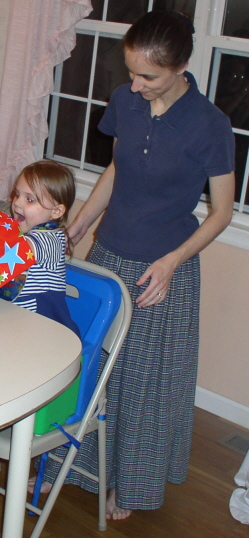
Here’s how I make these skirts:
I get a piece, or pieces of fabric, about three times as wide (total) as my hip measurement, and a few inches longer (maybe 4-5, to be “safe”) than I want the finished skirt to be, along with a little extra for the drawstring. The width of the skirt is somewhat approximate, but you will want it to be on the wider side if the fabric is very thin, and a little narrower if the fabric is very thick. My hip measurement is somewhere around 33-34″, and I usually make my skirts about 90″ around. (This is very handy, since I can just use a piece of 45″ wide fabric for the front and one for the back. If the fabric can go sideways, you can also use a single length the size you want, and seam it up the back once.)
Sew your fabric together with however many seams you need to make a large “loop” of fabric. (It should basically look like a skirt; it just isn’t gathered at the top or hemmed at the bottom.) If you have a front piece and a back piece, you will need three seams; if you have one long piece, you will need one; if you are larger and need multiple pieces, you may have multiple seams. Just sew each piece to the next, with right sides together. Then iron the seams flat (either open, or off to one side).
Now that you have your giant “loop” of fabric, you need to make a casing in the top. I prefer to have my drawstrings on the outside (so I can get to them to tie the skirt snugly enough), so I use buttonholes to create openings. If you prefer, you can just use elastic in the waist, and you will not need these openings, but the skirt will, of course, not be as adjustable. With the skirt still inside-out, fold the top edge down a little – about 1/4″ is good – ironing it as you go. When you’ve gone all the way around, fold it down again, this time as wide as you will want your drawstring to be, plus a little more. I think mine are usually around 3/4″. (You should be making both of these folds to the inside.)
Now, this is the trickiest part. You want to make two buttonholes in what will be the center of the front of the skirt, in the outside of the casing. Find the center front of the skirt. (I like to mark it with a pin.) Make sure you are at the outside of the casing. (Where you’ve folded it under, you want to go to the outside of the skirt.) I am emphasizing all of this because I’ve sewn these in the wrong place multiple times! 🙂 Unfold the parts you’ve just ironed under, long enough to do the buttonholes. If your fabric is very thin, you might want to put a little scrap of fabric on the back where the buttonholes will be sewn, to support them. (I keep some scraps of old white sheet on hand for this. Just hold them there while the buttonhole is sewn – but don’t sew your fingers!) Now, sew your buttonholes, side-by-side, with just a little bit of space between them. Make sure they are in the right place before you cut the fabric inside them to open them up!!! To cut them, insert a straight pin at one end to block yourself from cutting through the end by mistake. Then use a seam ripper to slice up the middle, ending at the straight pin. (You can take the pin back out now.)
It’s all downhill from here. 🙂 Sew around the entire top of the skirt. Your aim here is to sew down the edge of the fold you made, leaving a casing for the drawstring to go through. The “right” way to do this is to sew it from the outside, but if you are having a hard time catching the edge of the fold, just do it inside out. (The stitching will be largely hidden in the gathers when you’re done, anyway, so any imperfections will not be highly visible. Just make sure the thread matches. 🙂 ) You’re almost done with the skirt itself!
All you have to do now is hem it. Measure the length. (I usually measure from the middle of the casing.) If you have a lot of extra fabric at the bottom, you might trim some of it off, but be sure to leave plenty for hemming. The easiest way for me to handle the hem is to fold the fabric up as far as I need to, to leave the bottom edge at the proper length. (The skirt should still be inside out.) Then, fold the raw edge down inside that first fold. Once again, sew around the whole skirt to catch those folds and set the hem in place. (I recommend doing this from the right side if you can manage it.) Then iron the hem. (It will look much more “finished.”)
To make a matching drawstring, I cut a strip of fabric as long as I want the drawstring to be (or longer; I can always trim it later) and four times as wide as I want the finished drawstring to be. (I usually cut it around an inch wide.) Very carefully, so I don’t burn my fingers, with the wrong side facing up, I fold the outside edges to meet in the center, ironing as I go. Then I go back and fold that in half, sandwiching the raw edges on the inside, again, ironing as I go. Then I very carefully stitch the whole thing along the open edge to seal it shut, and iron the whole thing flat.
To insert the drawstring, put a safety pin through one end and close the pin. Insert the safety-pinned end through one buttonhole and use your fingers to work it through the casing, around the skirt, and out the second buttonhole. Remove the safety pin. (I then tie an overhand knot at each end of the drawstring to keep it from unraveling or slipping inside the casing.)
Voila! A versatile, feminine skirt. 🙂

Hello it was an absolute pleasure to come across, and read your blog. You really have some interesting information that I will have to share with my wife. If your ever looking for fabrics Lauren & I would be more than willing to help. Just let us know. Have a great evening.
Josh & Lauren
http://www.trendyfabrics.com
Thanks, Josh! I don’t need any fabric at the moment (have a stash here I need to use!), but I’ve bookmarked your site – you have some good stuff. 🙂