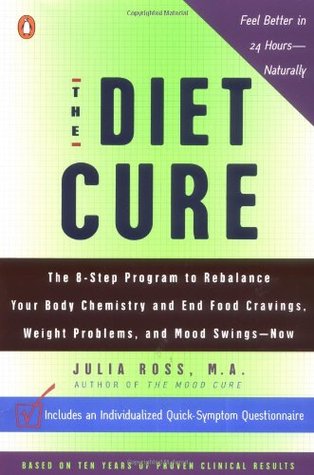
I just stumbled across The Diet Cure
For instance, L-tyrosine helps in the production of adrenaline, so if your body has been struggling to produce that, you can supplement the L-tyrosine while you heal, to help the process along. (I’ve not finished the book yet, so that’s a very undeveloped example.) There are other supplements out there right now that work on the same principle, like HCL (hydrochloride), which apparently helps osteoarthritis by similar methodology. (It helps the body produce substances needed for joint repair.)
This book addresses eight specific areas of ill health, several of which are ones I had already identified as likely issues with me, and offers solutions. (I haven’t gotten to the solutions part yet, so I can’t really vouch for its helpfulness yet.) If you’ve struggled with any of those “vague” systemic things like yeast overgrowth or hormonal imbalance, you might see if your library has a copy of this.
Update: After Reading The Diet Cure
I finally finished reading The Diet Cure
I’m having trouble wrapping my head around how to eat enough of the foods the author recommends, though — and how to afford doing so!
For instance, one reason I tend to snack on carbs rather than on low-carb veggies is that low-carb veggies are entirely too low in calories. A slice of homemade whole grain bread is about 110 calories, if I recall correctly. And it’s really easy to add a little bit of butter to that and eat around 175 calories.
To get that many calories from carrots, I would have to eat something like nine or ten whole (full-size, not baby) carrots. But nine or ten whole carrots is a lot of food to eat for a single snack. Does anyone eat nine carrots at a time? It’s just too hard to eat enough of these low-carb veggies to add up to sufficient calories.
And how does one afford to eat dinners that emphasize both protein and vegetables, and use almost no grains, potatoes, etc.? The protein and vegetables are the expensive parts of the meal, the grains the cheaper portion.
Am I missing something? How do people do this?
Originally published on 16 Feb 2010 & 22 Feb 2010; combined on 26 Jan 2021.

Leave a Reply