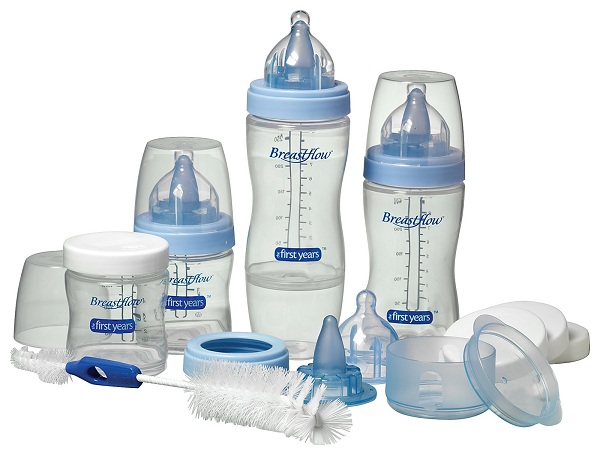
As many of you know, I’ve been struggling with some chronic health issues for a while. One of the most significant is the development of some food sensitivities — including some new ones that appear to have come about in the months after Caleb was born. Unfortunately, that has made it really hard to get enough food in me to sustain me, never mind me and a baby, so my milk dried up fairly early on, and I had to get Caleb on a bottle.
But he didn’t want a bottle.
Try as I might, and despite the fact that he was clearly not getting enough to eat, I could not get him to drink from a bottle. Desperate to find something that would work to get sufficient sustenance into my baby, I ordered every bottle I could find on Amazon that said it resembled the breast in some way, shape, or form. These Breastflow bottles are the only ones he will drink from.
I mean, seriously, he is really stubborn about it. We could be past time for the next feeding, having been out running errands, at my mom’s where we had some of his milk stashed. He could be screaming with hunger. But if that milk — the same stuff he drank all day every day — was not in his bottle, he would. not. drink it. (We bought extras to stash at Mom’s!)
So What’s So Special About These Breastflow Baby Bottles?
Unlike other bottles, which are designed to mimic the shape or feel of the breast, Breastflow bottles are designed to mimic the sucking motion of the breast. You may have noticed in the picture above that the bottle nipples look weird. That’s because each bottle actually has two nipples – an inner and an outer.
The inner one is (relatively) stiff. The outer one is the kind of flexible silicone you’re accustomed to seeing for bottle nipples. This pairing of the two parts allows for a simulated “let-down.” Baby sucks, the milk lets down into the outer nipple, and then he has to work at sucking it into/through/out of the inner one.
Now, clearly, I haven’t done any scientific studies on these. (And I can only assume that they simulate it as they say they do. Caleb certainly seems to think these feel more like nursing did.) But I would imagine that since they simulate the same type of suck as breastfeeding, they would convey some of the benefits of breastfeeding that bottle-feeding typically does not.
See, breastmilk is not the only aspect of breastfeeding that’s beneficial. The contact with mom during the process of nursing causes a communication between mom and baby that telegraphs what antibodies are needed so the milk can be produced accordingly. That, obviously, can’t be reproduced with a bottle. The process of sucking is beneficial, too, though.
A breastfeeding baby’s suck is different from a (typical) bottle-feeding baby’s suck. And the natural sucking of a breastfeeding baby contributes to jaw and verbal development, as well as impacting the ears. Simulating this suck as closely as possible can only be a good thing!
Did your babies have a bottle preference (or bottle aversion)?

Leave a Reply