
For some crazy reason, even when a woman has a pretty good sense of her best style and colors, this information often gets thrown out the window when it’s time to go formal (or semi-formal). She’ll pick one she thinks is pretty and, often, it just doesn’t suit her. (We see this more often than we should in Hollywood, where personal stylists — who should know better — are still making bad choices.)
One difficulty is that certain types are over- or under-represented in the formalwear world. But if you look, you can find something that will flatter, when it’s time to look for a prom dress, a gown for a Christmas party, etc. For the sake of example, let’s go for just the four basic types. (If you have a strong sense of style, you can probably get more specific, but this will help limit the number of examples needed for this post!) All of the examples here are taken from http://www.jenjenhouse.com/Prom-Dresses-c18/, and their photos are used with permission.
Type 1/Spring
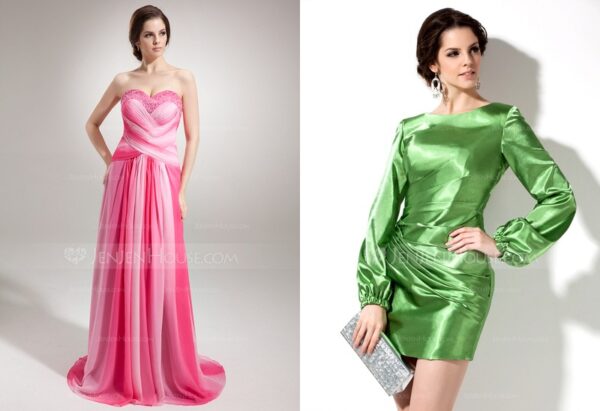
The classic “type 1” or “spring” type is light, airy, and fun or animated, with spring-like colors. Honestly, a full-length gown is probably almost never going to be her top choice. The sheer length of it weighs her down. But sometimes the occasion calls for the length..
In that case, the pink dress below might be one good option. It seems to feature a heart, which inherently carries animation. The variation in the shades of pink contribute to that sense of animation or movement, as well.
But if you don’t need full-length, the green dress is probably more classically Spring. The color is light/bright, and a little warm. The fabrication is a little crisp (not flowy) and shiny. And the brief length doesn’t weigh down. (Personally, I wouldn’t wear it quite this short, but still above the knee.)
Type 2/Summer
The classic type 2, or Summer type, is soft and traditionally feminine. Curvy, flowing, and just generally softened/gentle in every way. These two dresses are excellent examples of soft fabrication, soft lines, and soft colors. (The purple is a bit softer. The blue is a bit clearer, possibly better suited for a Summer who borders on Spring.)
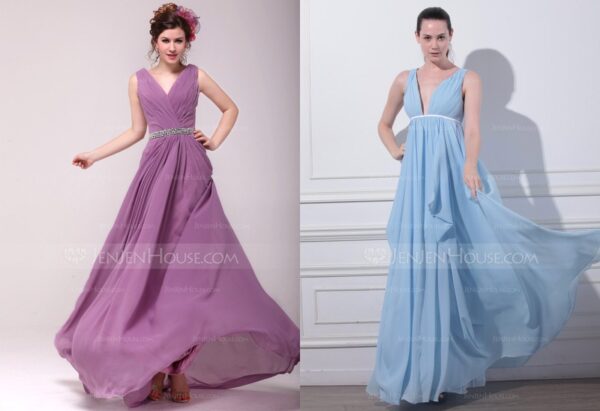
(These dresses are available in other colors, too, by the way.)
Type 3/Autumn
I had the hardest time finding formalwear well-suited to the classic type 3 or Autumn type. There’s so much shine and flow, and cool colors seem to dominate. This type is best with rich, warm (or at least warmish) colors, texture, asymmetry, and substance. Metallic is good, but not the glossy-shiny variety. (Some of the dresses available at jenjenhouse.com would work well in colors that are available, just not in the colors that are pictured.)
These two are options, though. The chocolate brown is a little on the shiny side for this type, but the chocolate brown is a good alternative to black. The fabric is crisp, without a lot of excess to create flow. The V neckline is excellent, as this type is generally comprised of angles. The design doesn’t have an obvious asymmetry, but it’s subtly so — just enough to not be obviously symmetrical.
The gold dress, with its one-shoulder design, has clear asymmetry. The ruching/folds in the bodice create texture. The fabric is a bit more matte, and appears to be substantive, as well.

Type 4/Winter
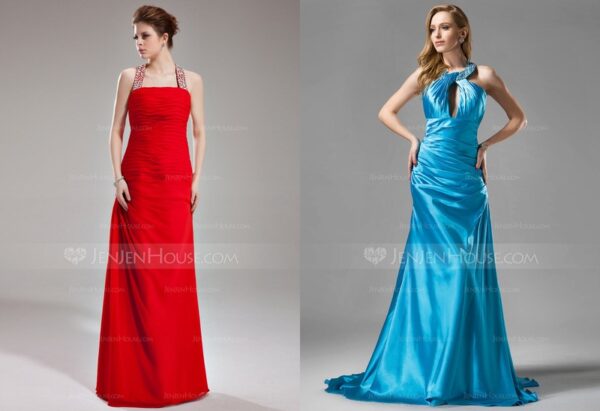
The classic type 4 or Winter type should have no problem finding formalwear. This is the woman for whom formalwear is typically made. Sleek lines, bold colors, and strong contrast look stunning on this woman. Simplicity is your friend if you’re this type, so don’t feel you need to “add” anything. The very simplicity of a basic dress will work in your favor.
I would encourage you to challenge yourself to aim for color, though, instead of black. You’re the one who can wear black and look amazing in it. But it’s easy. Try some color. Just remember to keep it strong/bold, like the red and blue here.

[…] the primary use of a prom dress is to wear it! You’ll search for just the right one, whether it’s for an actual prom, or for some other formal/semi-formal event, fix up […]