Many of my readers are probably familiar with Dave Ramsey and the envelope system of budgeting he recommends. (Some of us are actually not very familiar with Dave Ramsey, but are familiar with the cash envelope system.) The problem with having multiple envelopes is that they have a tendency to fall all over the place, so he sells an “envelope wallet,” which is basically a little bound book of envelopes. But it’s boring.
A while back, I encountered a dressed-up, home-crafted version of the envelope book, at Creativity in Progress and Jar and Jug. Both used the template (and, at least to a degree, the tutorial) posted by Kelleigh Ratzlaff.
When I decided to make one for myself, I used the same envelope template; however, I used a different process to bind them together. (Had I remembered there was a tutorial there, I probably would have done it her way. Mine is more complicated. However, it does have the added advantage of letting me use the booklet on its own if I want to, rather than just in my wallet.) I bound it much like a hardcover book.*
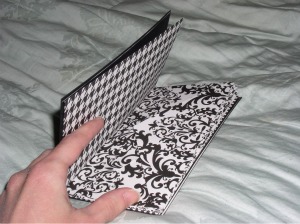
Here’s how I did it.:
First, use the template from the link above to cut out and fold as many envelopes as you want in your book. (I found that I could trace the template horizontally on a 12×12″ piece of scrapbook paper, and it fit. The side tabs hung over the sides just a tad, but there was enough tab for the envelope construction to work.) Don’t glue them yet!
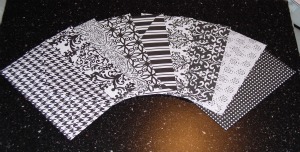
(Here I’ve pulled an envelope out of the “stack” and unfolded it so you can see – it’s been cut out and folded, but that’s it:)
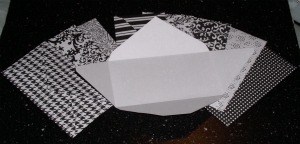
When your envelopes are all cut out and folded, open them back up. Then, in the crease that will be the bottom of the envelope, punch eight holes. (I used a large, open paper clip.) There should be eight holes — one about half an inch from each end, and two that will “fit” on either side of each of three pieces of ribbon. Unfortunately, the holes are bit difficult to see in this photo.

Here I’ve laid my pieces of ribbon across so you can see where the holes will be. (The ribbons will not be on the inside of the envelope; I’m just showing where the holes should be punched.) Be sure to punch all of your envelopes, and be sure your holes match from envelope to envelope. (I punched the template, then used it as, well, a template, to punch the “real” envelopes.)
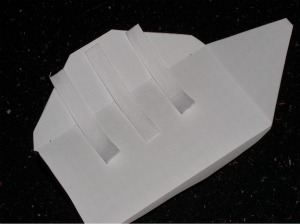
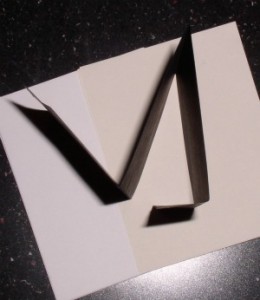
This next part is a little tricky to describe. You will need another piece of paper for each end of the book, because you don’t want to glue your envelopes to the end pieces. So you need a piece of paper the height and width of the envelopes, but it needs a little tab at the bottom so there’s a crease in which to stitch it. If your paper is only printed on one side, you will need to cut it extra-wide, and fold it so that it looks (when viewed from the end) like the picture below. This serves to keep the blank side to the inside and give you a printed side on both sides of the resulting “page.” (It doesn’t really matter how wide the tabs are; you just need to have some tab so you can sew it.) If your paper is the same on both sides, you don’t need to do all this folding. Just cut a piece that is the same height as your book and a bit wider, then fold that excess over to make the tab.
Now you will sew the book together. Stack everything together the way it will look when it’s finished, so you know what order the pages go in. The ribbons will go on the outside of the whole thing. Thread a large needle with a very long length of dental floss or embroidery floss, but don’t knot the end. Go in through the hole at one end, then out the next hole. When you go in the next hole, you should sandwich the first ribbon against the book with your stitch. Continue down the spine in this manner.
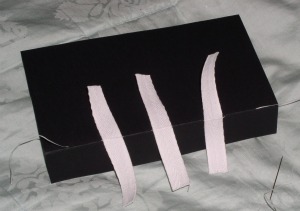
When you get to the other end, add the next “page” (your first envelope) and stitch along it in the same manner but the opposite direction. Be sure to sandwich the ribbon. Be sure your envelope is facing the right direction! I checked mine at the beginning and end of each one, just to be sure, because it’s really easy to get them turned around. At the end of the first envelope, tie the floss you’re working with to the original end. Add the next envelope and stitch along it in the same direction as the first (non-envelope) page. At the end of it (and the end of each “page” after this), take a “kettle stitch,” then go on to stitching the next envelope. (A kettle stitch is much simpler than most diagrams make it look. To make one, take your needle under the stitch that goes between the previous page and the one before it and then bring it through the loop created by the length of thread before you pull it taut.) This all sounds complicated because it isn’t easy to explain, but it’s actually very quick and pretty simple. When you’re done, it should look like this:
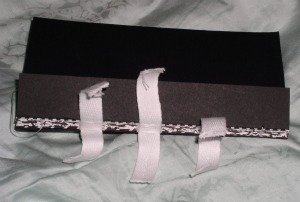
For added strength, you can use a paintbrush to “tap” glue onto the spine all the way down.
And here you can see where the envelopes are still open. Now it’s safe to glue the envelopes into their “finished” state. Just be careful not to glue them shut.
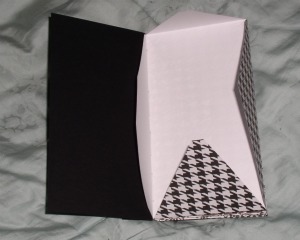
Cut two “endpapers.” When folded in half, they should be exactly the height and width of the envelopes. Fold them in half. (I used cardstock for these, and for the end “pages” I bound in, which gave some structure. These endpapers, at least, should probably be cardstock.) Glue them to the ends of the book, as shown: (The ribbons should still be on the outside, and the “inside” halves should be glued to the end pages that you sewed in, enclosing the little tab section.)
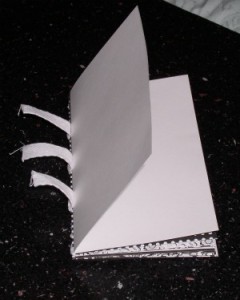
Now cut a cover. I used cardstock for this, too, but you could use a decorative paper if your end papers and such are sturdy enough. When wrapped around the book, it should be about an inch or so larger at each edge. Glue the book into it, enclosing the ribbons. (The ribbons should be glued to the end papers, then that whole thing — ribbons and end papers — should be glued to the cover.) This picture shows it with one side glued in, but you will, of course, glue both sides.
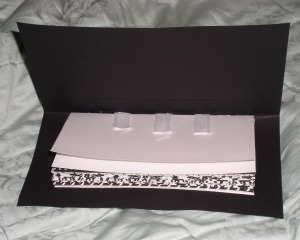
It will look something like this:
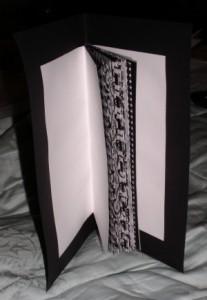
Notch out the corners of the covers, wrap them around the endpapers, and glue them down, like this:
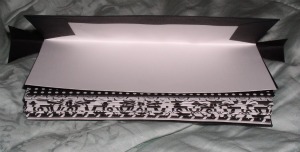
Finally, trim off the pieces you see sticking off the ends in the above picture, and then glue the halves of each end paper together, enclosing/covering up the folded over pieces of the cover paper. Put waxed paper between this and the first envelope at each end (so you won’t glue them together by mistake) and place under a stack of books to dry overnight.
When you’re done, you should have a nice, neat little book of envelopes. 🙂
*If you’re familiar with bookbinding, this will all sound very familiar. I didn’t really diverge from the normal process until after adding the endpapers. I had actually cut and assembled a real cover, but I decided it was too bulky and unnecessary for my purposes.

I used the envelope system for many years. I purchased a small ring binder (small planner) with a zipper and I punched reinforced holes in snack-size ziplock bags: In each ziplock, I put a 4×6 index card cut to the correct size and I punched through the non-zip side. Each card had the category written on it and the amount that I usually allocated to that category (in correct denominations, so I knew what to get from the bank each time).
So it just looked like a small planner, not a wallet. When you opened it up, all my categories were in there. If a zipper bag got worn out, it was cheap to replace (I can’t recall ever having to).
I had a card in the back with the full bill-denominational breakdown for each bank run (mid-month, end-of-month).
Yours is prettier! 🙂