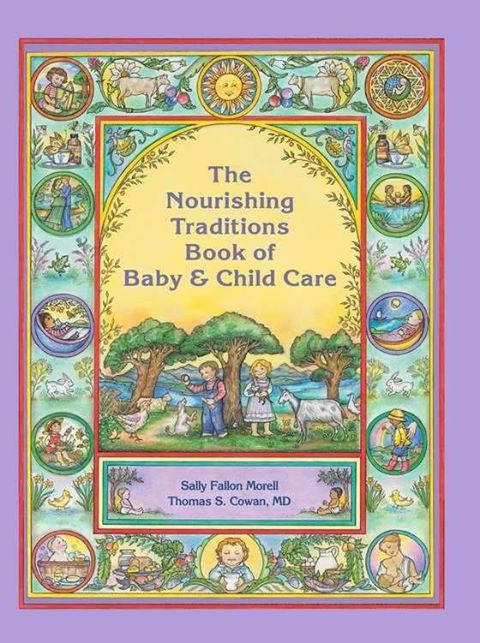
Most of you are probably at least vaguely familiar with Nourishing Traditions. If not, you should check it out. I don’t agree 100% with everything in the book (when do I ever?), but it’s the best resource I know of for information about real, traditional foods and their impact on our health (with practical applications). It is CHOCK. FULL. of great information you’ll have a hard time finding elsewhere. In particular, it aims to put Dr. Weston A. Price’s research to practical use.
Well, now there’s The Nourishing Traditions Book of Baby & Child which I was given the opportunity to read and review. I expected this to be all about nutrition and feeding – and there is a heavy emphasis on diet – but there is other content here, as well.
As is the case with all books, it’s colored by the author’s worldview. This would have had a bit less impact if this were a nutrition-only book, but it’s not. As Mrs. Fallon Morell does not write from a biblical Christian worldview, this comes through in places. (The book alludes, for instance, to evolution.) This as to be expected, and although there are elements here or there that I would, personally, filter out of our own application, it’s no more than what I would expect to find elsewhere. I also appreciate that the why is almost always provided, so if you disagree, that’s okay – you still know exactly what you’re choosing to skip over.
In application, there are only a couple of specific details that stood out to me in this category of, “no, I don’t agree with that.” First, the author discourages “attachment parenting,” and is concerned that holding babies almost all of the time is not good for their development. (She does not advocate putting them down all the time, either; it’s actually pretty balanced. But there is just a tinge of the idea that if you hold your child too much, it will be bad for him.) She recommends both tummy time (good, of course!) and “45-degree-angled seats.” Seats are actually not very good for little babies’ spinal development. We use a bouncy seat in our house (which would fit her definition), because it’s soft and “slinglike,” but we try to avoid using it too often – and will not use hard-sided seats like swings and carseats – because babies are not meant to have flat, straight backs yet. (I just re-read that and realized it sounds like we never use a carseat. We do, in the car! Just not for general sitting purposes.)
The other is more of a caveat. She says that babies should be sleeping through the night by 3 months, and if they aren’t, to check your diet. Well, 3 of my 4 babies have started to sleep through the night before 3 months, but immediately ceased to get enough food and (thankfully!) began waking (once a night) again. Probably “check your diet” would be in order, as I struggle to ingest enough food in any given day. But I would caution against being too dogmatic about getting a little one to sleep through the night if he might not be getting enough. You don’t want to keep him from getting enough to eat!
(I would have taken issue with her insistence that babies should begin solids at 4-6 months, having seen convincing evidence to the contrary, but she offers some pretty convincing evidence to support her view! Whether or not you decide that you ultimately agree with her, she does offer the same recommendation I would – that babies’ first foods should not be cereals, or even fruits and vegetables, but meat and other animal foods. I would strongly recommend against adding anything but animal foods this early.)
These are really some minor details within the bulk of a very information-heavy book. The first several chapters talk about nutrition, and do so in an extremely detailed manner. Chapters are devoted to preparing for pregnancy (that is, pre-pregnancy nutrition), nutrition during pregnancy, and (later in the book) for growing babies. Each nutrient is taken, one by one, and the reader is informed of its specific importance, how to obtain it, etc. (As I said, there’s lots of “why” here!)
In addition, other topics relevant to health during pregnancy, birth, and the rearing of a young child are addressed. Topics such as birth and newborn interventions, vaccinations, and circumcisions are tackled, providing information that you rarely see in other sources. Who else is willing to be politically incorrect enough to question whether Rhogam is essential by default, or whether we really ought to be vaccinating our children?
As always, the information is provided so you can make a truly informed decision. Very often, studies are referenced. And almost always, the author’s approach is balanced, not falling into any ditches (unless the science itself is very obviously one-sided), but leaving the door open for variances from family to family. And although she advocates against vaccinations, for instance, she provides suggestions for what to do to mitigate the negative consequences if you must vaccinate. These are very sound, common-sense recommendations that mesh with my own conclusions based on my other reading/research.
Even childhood illnesses are tackled! Natural alternatives are offered for typical “over-the-counter”-type treatments of a variety of childhood ailments. These range from the simple (like colds) to more complex (like asthma and autism). (By the way, I’m not suggesting that she claims to treat something like asthma or autism with the same completeness as, say, a common cold. Just that recommendations are given for both categories of ailments.) Because she doesn’t recommend the administration of vaccines, so-called “vaccine-preventable illnesses” such as whooping cough are not omitted, as they are in most other children’s health books.
There are some sections, as well, that address growth, development, and child-rearing philosophies. I don’t completely agree with her concept of development (as brought up during the book’s introduction and carried through these sections and even somewhat into the childhood illness section). Based on the work of Rudolf Steiner, it deals with four stages of development, each seven years long, in which four different “bodies” are developed: the physical body, the etheric or life body, the emotional body, and the ego body. So much of the explanation in this system does not correspond to my worldview. However, I did not find that any of the application was negatively affected by this. In fact, I found the vast majority of the book to be extremely well-balanced and reasonable.
Personally, I find it a bit overwhelming to read about the true impact of diet on children. It makes me feel a little helpless, in a society where it is so expensive to eat a diet comprised completely of truly healthful foods. That’s probably why so little of our literature is willing to tell the truth about the significant effect it can have! (Some older books discuss similar topics, but nothing else I’m aware of that’s currently in print.)
However, the author’s tone throughout comes across to me as very “calm” and down-to-earth. She makes no bones about the fact that what we eat – and other decisions we make regarding what to put into our children’s bodies, and into our own – can have large and wide-reaching impact. But there is nothing “alarmist” about anything here. One does not get the impression that she is trying to scare you or manipulate you, or use some other “tactic” like this. Rather, one gets the impression that she is merely laying out the facts.
Most of the book is information, not recipes, but there are 17 pages of recipes in the appendices. These largely deal with organ meats, fermented foods, and the like – things the average home cook probably isn’t familiar with preparing. Keep in mind that if you’ve been eating like most Americans, they will be very different from what you’re used to. (Before someone takes a look at the book and asks me…I’m not sure I’m comfortable with raw liver – even frozen to supposedly kill pathogens. But raw eggs are arguably quite safe as long as they come from a trusted source. I wouldn’t, personally, eat regular supermarket eggs raw.)
This is an excellent all-around health book for expectant mothers or mamas of newborns (or older children, for that matter). With the caveat regarding worldview, I heartily recommend it.
I have been asked to mention that the book I have recommends Swedish bitters for pregnant mothers, in certain circumstances. Since this printing, it has been brought to the author’s attention that these might not be safe for pregnant women, and it is recommended that you not take them during pregnancy. (For more information, see this post.) This will be corrected in upcoming printings, and may even have been addressed as of this writing.

Is there a cookbook you would recommend I should use during pregnancy? My family and I try very hard to stear clear of processed foods, eat mostly organic and grassfed beef and butter along with raw milk. We have no food allergies. I have trouble getting us to eat a balanced meal throughout the day and would like a good cookbook to get us on track. Thanks