
When I first began milling flour as a newlywed, I had a WhisperMill. After a few years, I replaced it with a NutriMill. Then, just a year or so ago, as part of the Grain Mill Wagon, I was blessed to receive a WonderMill (same essential design as the WhisperMill*, new company). Given my experience with both, I thought I’d compare them for you and tell you why I prefer the WonderMill/WhisperMill.
Both Mills are Good Mills
First of all, let me be clear that both are very good mills. I wouldn’t hesitate to recommend either one. They will do the job, and do it well. But we do have a choice, so what are some things that might make a user prefer one over the other? That’s what I’m going to look at in the rest of this post.
Benefits of the NutriMill
When I first switched to the NutriMill, there were reasons. I mean, I already had a mill, so there had to be motivation for passing it on and replacing it with something different, right? There were three advantages in particular:
- The mill doesn’t have to be turned on before adding the grain. (This was the biggest “selling point” for me, because I was afraid my kids would dump the grain in first and jam the mill. But keep reading…)
- The hopper holds more grain at a time, and is supposedly perfectly matched to the size of the flour bin.
- This has a slightly smaller overall footprint, because the flour bin goes under the mill instead of beside it. (This was not particularly important to me, but it’s worth noting.)
Unfortunately, I didn’t find most of these things to be of actual benefit in a real-life situation. It is true that the mill doesn’t have to be turned on first, and that’s nice. But doesn’t make as much of a difference as I’d thought.
The hopper didn’t seem to hold as much more grain as it was said to (although it did hold some more — it’s hard to measure exactly, because you’re not supposed to leave the grain to sit in the WonderMill, so it’s “disappearing” as you add it). More significantly, though, the hopper was nowhere close to matched with the flour bin’s size.
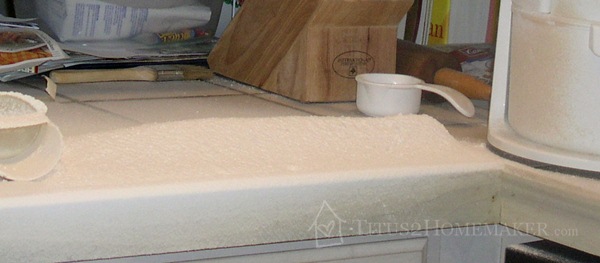
Once (once!) I almost filled the hopper, and I turned the mill on and walked away. (Big mistake!) The flour so overflowed the bin before I came back in and “caught” it, that every surface in that end of my house was dusted in white and I literally had drifts of flour in piles in the kitchen.
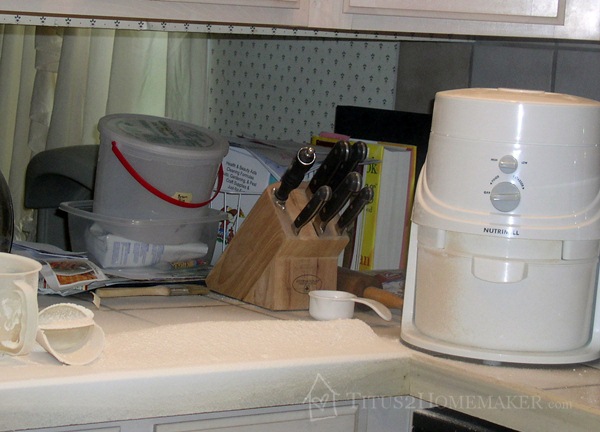
(Let’s see that again a little closer.)
Benefits of the WonderMill
The WonderMill does have a slightly smaller capacity, and has a slightly larger footprint when in use, but it has a number of benefits.
- Better flour bin design
- Quieter
- Smaller footprint when not in use
The design of the flour bin is the biggest advantage, to me. The difference may seem minor, but it makes for several practical differences. The NutriMill lid twists on, with a tab locking into place inside a slot. There’s a gasket to help keep flour from blowing out. This gasket has to be floured before it will twist properly (it sticks otherwise), and I still typically have trouble with it the first time I use it after washing the bowl. This discourages me from washing the bowl as often as I otherwise might. Worse, flour still blows out!
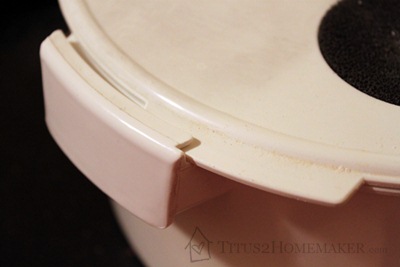
The WonderMill lid snaps on. As long as you make sure you hear it click (and as long as you have pushed the connecting tube into the mill all the way), it doesn’t blow. I have never, ever seen one blow flour unless the lid wasn’t on all the way or it wasn’t firmly attached. And it’s much easier to get on and off. Washing it doesn’t cause any problems.
When I first got the NutriMill, I didn’t think it was notably louder than the WhisperMill — just pitched differently. But there is a difference. It’s not a deal-breaker, but the quieter motor is nice. (Both machines are loud, though. There’s really no getting around that — there’s a motor running and grain getting all crunched up!)
Finally, as odd as it sounds, the WonderMill has a smaller footprint when not in use, even though the NutriMill has a smaller footprint when it is in use. The base portion of the machine is smaller in the WonderMill than the NutriMill. The NutriMill’s flour bin stores “inside” it, though, so the footprint never changes. The WonderMill’s flour bin attaches to the side, increasing it’s footprint during use, but then removes so the smaller base size is what you’re left with.
What about the issue of adding grain before the mill is turned on? Well, you’re still not supposed to add the grain to a WonderMill before turning it on. However, if someone goofs and does this, it’s not as big a deal as I was led to believe in the past. If this happens, you just dump the grain out, turn the machine on, and pour the grain back in. The company even has a video of them turning the machine on and off with grain in the hopper, to no ill effect.
*I don’t know all of the details, but WhisperMill went out of business a number of years back, and WonderMill picked up production on what is, essentially, the same mill.
This post is being shared at Fat Tuesday, Titus 2 Tuesday, Healthy Tuesday, Natural Living Monday, Homemaker Monday, Mostly Homemade Mondays, Real Food Wednesdays, Wildcrafting Wednesday, Simply Natural Saturdays.

Since the WonderMill got a huge upgrade on the motor several years ago, we have done some testing with filling the hopper before turning the WonderMill on and it seems to have no problem with it. So don’t worry about accidentally filling your bill before turning it on or loosing power while grinding with the WonderMill, it will start grinding again no problem when it is turned on or the power is restored. See this demonstration video http://www.youtube.com/watch?v=eiwhtgsKkbY
So with the NEW designed Nutrimill Plus does it change more to the New Nutrimill being the better option or have you tried comparing the Wondermill now?